Day Fifty Seven

Today I'm going to share some favourite poems with you.


Bed in Summer
Robert Louis Stevenson

It echoes every child's dislike of having to go to bed while the sun is still high in the sky and there's so much more playing to do - but for that Tyrant Time.

In winter I get up at night 
And dress by yellow candle-light. 
In summer, quite the other way, 
I have to go to bed by day. 

I have to go to bed and see 
The birds still hopping on the tree, 
Or hear the grown-up people's feet 
Still going past me in the street. 

And does it not seem hard to you, 
When all the sky is clear and blue, 
And I should like so much to play, 
To have to go to bed by day?
                             
                                                                  *******

Dorothy Parker had an unhappy childhood and despite her success as a writer, was no luckier as an adult.  She married 4 times, twice to the same man.  After her death, her ashes lay unclaimed for over 17 years.  Poor, unhappy woman - but a truly brilliant writer.
Dorothy Parker

Love Song
Dorothy Parker

My own dear love, he is strong and bold
      And he cares not what comes after.
His words ring sweet as a chime of gold,
      And his eyes are lit with laughter.
He is jubilant as a flag unfurled—
      Oh, a girl, she’d not forget him.
My own dear love, he is all my world,—
      And I wish I’d never met him.

My love, he’s mad, and my love, he’s fleet,
      And a wild young wood-thing bore him!
The ways are fair to his roaming feet,
      And the skies are sunlit for him.
As sharply sweet to my heart he seems
      As the fragrance of acacia.
My own dear love, he is all my dreams,—
      And I wish he were in Asia.

My love runs by like a day in June,
      And he makes no friends of sorrows.
He’ll tread his galloping rigadoon
      In the pathway of the morrows.
He’ll live his days where the sunbeams start,
      Nor could storm or wind uproot him.
My own dear love, he is all my heart,—
      And I wish somebody’d shoot him.
                                                         *********

Henry Reed (22 February 1914 – 8 December 1986) was a British poet, translator, radio dramatist, and journalist.


Lessons of the War: I: Naming of Parts
By Henry Reed


Today we have Naming of Parts.
Yesterday, we had Daily Cleaning.
And tomorrow morning, we shall have What To Do After Firing.
But to-day, today we have Naming of Parts.

Japonica glistens like coral in all of the neighbouring gardens,
And today we have naming of parts.
This is the lower sling swivel.
And this iIs the upper sling swivel, whose use you will see,
When you are given your slings.
And this is the piling swivel, which in your case you have not got.

 The branches hold in the gardens their silent, eloquent gestures,
Which in our case we have not got.
This is the safety-catch, which is always released
With an easy flick of the thumb.
And please do not let me see anyone using his finger.
You can do it quite easy if you have any strength in your thumb.

The blossoms are fragile and motionless, never letting anyone see
Any of them using their finger.
And this you can see is the bolt.
The purpose of this is to open the breech, as you see.
 We can slide it rapidly backwards and forwards: we call this
Easing the spring.

And rapidly backwards and forwards the early bees are assaulting and fumbling the flowers:
They call it easing the Spring.
They call it easing the Spring: it is perfectly easy
If you have any strength in your thumb: like the bolt,
And the breech, and the cocking-piece, and the point of balance,
Which in our case we have not got; and the almond-blossom
Silent in all of the gardens and the bees going backwards and forwards,
For today we have naming of parts.


Walter James Redfern Taylor was an Australian born poet and writer who left his home for England when he was just 18. He wrote the following poem in 1916.

Romance
W.J. Turner

When I was but thirteen or so,
I went into a golden land,
Chimborazo, Cotopaxi,
took me by the hand.

My father died, my brother too,
they passed like fleeting dreams,
I stood where Popocatapetl
Mt Chimborazo

in the sunlight gleams.

I dimly heard the master’s voice
and boys far-off at play,
Chimborazo, Cocopaxi
had stolen me away.

I walked in a great golden dream
to and fro from school –
shining Popocatapetl
the dusty streets did rule. 

I walked home with a gold dark boy
and never a word I’d say
Chimborazo, Cotopaxi
had taken my speech away:

I gazed entranced upon his face
fairer than any flower –
O shining Popocatepetl
it was thy magic hour:
The houses, people, traffic seemed
thin, fading dreams by day,
Chimborazo, Cotopaxi.
They had stolen my soul away.
                                                                     ********** 

 And this is one of many nonsense poems I wrote for my grandson. 

 The Bombardon 

We once had a truly amazing bombardon
All padded with vervet which came from Des Moines
It could be quite dangerous, (but we kept the guard on)
The rampikes and pronks were all weighted with foins

 The edges were colloped with many edmenage 
The doors, when they opened, revealed a bezoar
Klipspringers abounded and quite an advantage
Were fifty five cats, a zedonk and a boar.

 The things I liked best were perdicular boskets 
Which hung from the corners, all covered with flumes
They sparkled with silver, as did the pearl oskets,
Except when the mithridate gave off its fumes.
  
When father developed a bad diaeresis
He raged in delirium, ‘Sell the darned thing!’
My heart, callithumpian, heard this sad thesis
I even considered a note to the King.

 The sad day arrived, the bombardon was taken 
A gold ninnyhammer fell, clunk, to the floor
And now in the night when I often awaken
I mourne my bombardon, I'll not see it more. 


Day Fifty Six

Strange behaviours in the animal world


It’s Autumn in Laguna, Brazil and the local fisherman are standing knee deep in the water, holding nets and waiting.
Before long a pod of Bottlenose dolphins appear but they are not what the nets are for.
The dolphins work together to herd schools of fish, mostly mullet,  towards the men.

Then, when they decide the time is right,  the dolphins give a signal by slapping their heads or tails on the water and at this, the men throw out their nets.  
The fishermen will not move until the dolphins tell them to do so.

 As the mullet dart about, the dolphins pick up any not already captured in the nets.
This symbiotic relationship has been going on for generations and just as the Laguna men teach their sons the rules of the game, the dolphins too educate their own offspring in exactly how to help their human collaborators.  
Toxic Madagascan Millipede
In the jungles of Madagascar, Black Lemur gather highly poisonous millipedes. They don’t eat them, just annoy the heck out of them so the huge insects exude a toxic substance containing cyanide. 
This the lemurs rub on their fur to deter mosquitoes; cyanide is an effective pesticide.
But that’s not all.  In the process of this strange anointing, the lemurs get high and disorientated and show clear signs of addiction.

Naturalists have observed this drug habit and the lemurs; desperate need to acquire the narcotic to get wasted.
 It’s not known if the millipedes, usually discarded unharmed, benefits in any way.


Addicted Vervet monkeys, originally from Africa,  live on St Kitts in the
 Caribbean.
They’ve developed a taste for alcohol and each monkey has it’s own preference.
Some go for cocktails, others for the hard stuff and if there are no tourists around to steal from, they’ll raid the local bars.

For years, scientists have studied the monkeys for insights into  human addictions
But not all are chronic boozers, some monkeys, despite the majority in their troupe knocking back the vodka, remain teetotal and won’t drink alcohol even when offered it.    Like humans, the drunken monkeys wobble and fall about and tell their best mates they love them.
 
This monkey rejected the alcohol in favour of the non-alcoholic drink with the straw 

Hedgehogs are immune to many poisons and have been known to collect and eat cigarette butts.  This creates strange behaviours - writhing around and
 contorting their bodies and spitting their saliva onto their spines.
As nicotine is an insecticide, scientists assume the hedgehog has worked this out to keep it free of parasites.


The popularity of aromatherapy is not just confined to humans who drop lavender oil on their pillows to help sleep.  
Starlings collect aromatic herbs for their nests and cover newly laid eggs with Yarrow, Mint, and Willow.
Research shows this helps the chicks' immune system as the oil is absorbed through the shell.
Chicks reared with herbs grow faster, weigh more and cope better with stress when they leave the nest.


Day Fifty Five

Your whole life shows in your face - be proud of that.
Lauren Bacall

Humans and animals are programmed from birth to look at the human face and deduce moods from what they see. 

 The eyes have it.   If I cover my eyes, I can get much closer to the birds I’m watching than if I advance, however stealthily with my face uncovered.

Birds look for the ‘eagle eyes’ or ‘hawk eyes’ of predators to reduce the risk of becoming prey.  If they can’t see the eyes, they don’t see the risk - although of course even if you wear a paper bag over your head, even a flock of bird-brains will take to the sky if you move suddenly in their direction.


At Cambridge University, a group of researchers trained sheep to recognise President Obama and actors Emma Watson and Jake Gylenhaal
Don’t ask me why. 
Jake Gylenhaal

Perhaps they wanted to discover why facial recognition software, first developed in the 60’s by Woody Bledsoe, Helen Chan and Charles Bisson, has taken over 50 years to develop - and still isn’t perfected, according to the BBC’s technology correspondent Rory Cellan-Jones

‘The more images you ask computers to process, the less accurate they tend to be.’ he says.

So the answer is clear: instead of dodgy software in top security buildings, just install a sheep.


The human brain is so attuned to facial patterns that we even see them in things which don’t actually have faces.  This is called “pareidolia”.


Despite the posh word, we’re not that good at identifying unfamiliar faces. 

When researchers presented guinea pigs (the human kind not the little squeaking creatures although  maybe the humans were squeaky creatures too) with two photographs and then asked them to differentiate on second viewing, 20% of people could not.


I’m hearted by this as it proves I am not alone.

I can’t tell the difference between Natalie Portman and Keira Knightley, however many times I see them and as every male actor between 20 and 35 has  a 4-day growth of beard, they all look alike to me.

I find it much easier to recognise a smiling handbag.


So who’s better at this face recognition thing, humans or computers?

“It depends on the task,” says Rob Jenkins, psychologist from York University.
“If it’s a human who knows the face they’re looking at, bet on the human every time. 
If it's a face that’s unknown, the machine has the edge.”

Okaay, let's recap:  humans who already know the face they are looking at, can recognise it?  

Did we really need research to tell us that?


And none of us can beat the sheep.


Day Fifty Four 

May 22nd Sherlock Holmes Day :The game’s afoot!


When Sir Arthur Conan Doyle wrote his very first Sherlock Holmes story, A Study in Scarlet (1887) he had no reason to believe how popular the character would become.   The story, rejected by other publishers, made not a ripple in the minds of the reading public.

It wasn’t until 1891 Holmes and Watson found their way into print again and
became firmly established with subscribers to The Strand Magazine, where A Scandal in Bohemia resulted in record sales.

The Guinness Book of Records list Holmes and Watson as the most portrayed characters in history. 
By 1990, well over 25,000 films, stage adaptations and TV series had been made featuring the consulting detective and his emanuensis, Dr John H Watson.
Dr Josephe Bell - Edinburgh
It is said Doyle was inspired by Joseph Bell a surgeon at the Royal Infirmary of Edinburgh and with whom Doyle had worked.
Bell, a meticulous observer, would draw conclusions (often correctly) from the slightest evidence.
Basil Rathbone and Nigel Bruce 

When Watson and Holmes first meet, Sherlock says:
‘You have been in Afghanistan I perceive’.
Dr Watson assumes someone told him and Holmes is quite affronted.

‘Nothing of the sort. I knew you came from Afghanistan. Here is a gentleman of a medical type, but with the air of a military man. Clearly an army doctor. His left arm has been injured. He holds it in a stiff and unnatural manner. Where in the tropics could an English army doctor have seen much hardship and got his arm wounded? Clearly in Afghanistan.'

It all sounds very plausible but some of the fun in being an addicted  Holmesian, is finding holes in the reasoning. All the things Holmes observed could easily have other explanations.


Francis “Tanky” Smith, a policeman who used disguises in his work, was another influence on Conan Doyle.
Smith with partner Tommy Haynes, known as Black Tommy were the first detectives in Leicester and had the courage and ability to infiltrate some of the city’s worst and most brutal criminal gangs.
Tanky looking uncannily like Stephen Fry


When Tanky retired, he built, with the help of his architect son, a property in Top Hat Terrace where several sculptures now show his many disguises.
The name Sherlock is now, along with Watson and Mycroft, firmly embedded in literary history but he was, originally named, Sherringford in early drafts. 
Quite a distinguished name in itself, unlike Ormond Sacker, the first incarnation of Dr Watson.   Thank goodness Doyle decided to change them.


Whilst most of us think of Sherlock in a cape and Deerstalker hat, there is no mention in the stories,  of Holmes wearing one. 
This image comes from one of the first illustrations in The Strand magazine (seen at the top of the page).

We all have our favourite actors portraying Holmes and Watson on screen. Mine are Basil Rathbone and Nigel Bruce, whose Watson was so endearing that he won my heart at an early age and I’ve stayed faithful to him for over 70 years.


I do admit though to finding Jeremy Brett and Edward Hardwicke worthy successors in the following decades.


Day Fifty Three


On 23rd May 2007,  author Luca Scantanburlo followed up a strange rumour. 

A man living in Rwanda had, some years before, been part of a NASA project which proved beyond any doubt that alien life had existed on the moon.

Curious, he tracked down and interviewed William Rutledge, an American astronaut, now retired but formerly part of the Apollo 20 crew who took part in a top secret mission to the moon during 1976. 

The mission, launched from Vanderberg Air Force Base, had been made jointly by the USA and USSR, the crew members including Rutledge,  astronaut Leona Snyder and Soviet cosmonaut Alexei Leonov.
They landed near Guyot Crater where Rutledge and Leonov took photos and videos of an ancient but now ruined, civilisation.
During subsequent interviews, Scantanburlo learned that the crew found and brought back to Earth, many artefacts and incredibly, the remains of a humanoid female.
Humanoid nicknamed Mona Lisa

All this was immediate put under the strictest security, the crew warned not to speak to the media and the whole mission subject to total deniability.


However,  31 years down the track, Rutledge had decided to go public and having made copies of the videos taken on the moon, promised the author  he’d upload  them to You Tube, which he did. They can still be seen today. 

Luca Scantanburlo wrote a book about the mission, the extensive interviews with Rutledge and the incredible finds on the moon.

The only problem?  The whole thing was a hoax.

It’s hard to discern from Scantanburlo’s website whether he was fooled by Rutledge; who mixed fact with fiction so that some parts of the story were verifiable; or in league with the hoaxer.  
His book was a best-seller but to date he is still listed as ‘a clerk in the hospitality industry’ and his website is mainly conspiracy theories.

Thierry Speth also wrote, in 2017 about the supposed mission.
"143 pictures from the mission .In 1971, Russian Probes and the Apollo 15 mission photograph a gigantic starship wrecked on the dark side of the Moon.

Worthy of Ripley's Believe it or Not!


                                                            *******
  
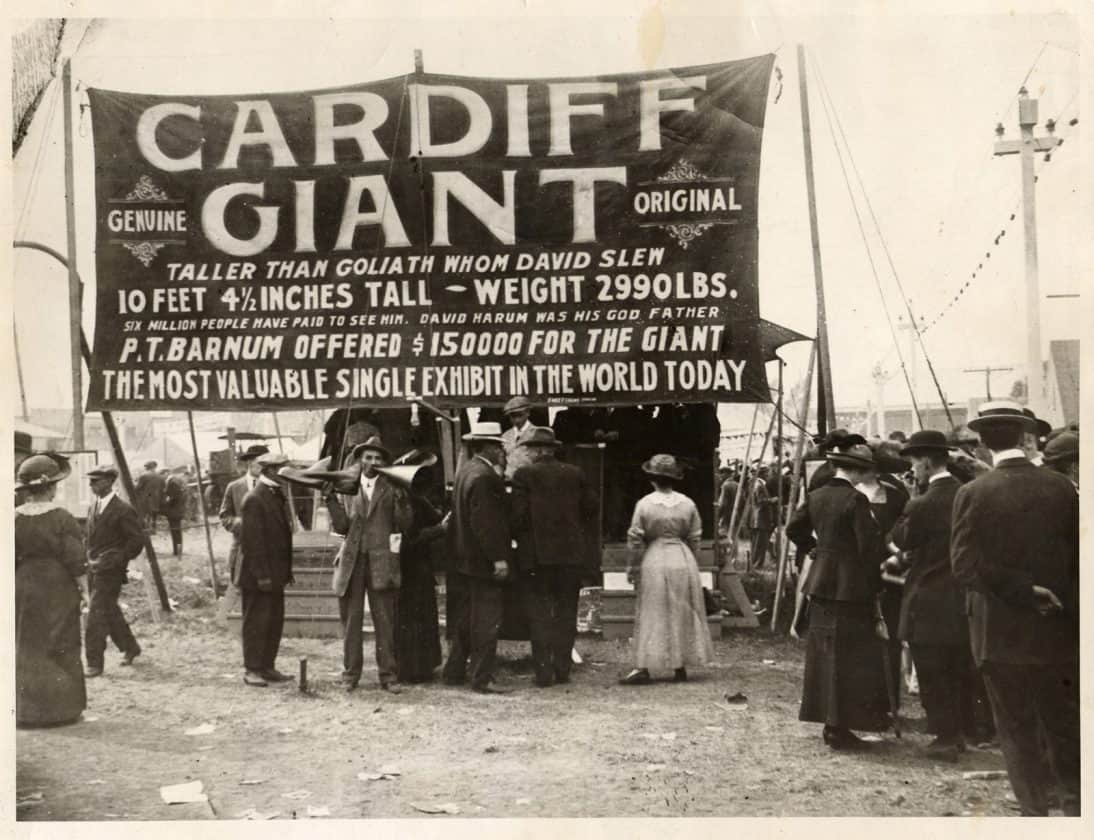
There were giants in the earth in those days Genesis. 6 v 4 

On October 16, 1869, two labourers, digging a well on a farm near Cardiff, New York, hit stone.
Carefully they examined their find. Buried amid tangled tree roots and looking old and worn was a giant figure.


‘I declare,’ said one, ‘looks like an old Indian has been buried here.' 

The Syracuse Daily Standard declared it 'a new wonder’ and the latest in a long line of fossil finds for which Cardiff was well known.

People came from far and wide; so many that Farmer Newell (known at ‘Stub’) erected a tent over the figure and began charging admission. 

 Two thousand five hundred people came to look (and pay) in the first week alone. 

Then a man named George Hull arrived and Newell, who had rejected several offers to buy the fossilised man who stood (or lay) approximately 10 ft, heard from Hull that a syndicate of businessmen were offering $30,000 for a three quarter stake in the phenomenon.     He accepted.

Several experts opined it was simply a statue rather than a human body, petrified by the limestone in the surrounding water but still, when the syndicate took it on tour, thousands came to look. 


Showman P T Barnum, always a man to recognise the way to bring in ‘the suckers and the dollars’, offered to buy the giant. When refused, he had a replica made and exhibited it as the real thing. 

P T Barnum circus poster


He covered all bases with his posters which read : 

What is it?
               Is it a Statue? Is it a Petrification? Is it a Stupendous Fraud?
                                Is it the Remains                                   of a former Race?


Barnum’s giant drew such huge crowds, far more than had flocked to the original, that he had several more made, touring in different areas of the USA.

Then suspicions began to be aroused when a few people in Cardiff remembered George Hull and how he’d been seen in town a year before, transporting a large crate.
The men originally hired to dig the well speculated that it was a strange place to have a well and anyway, there was other access to water on the Newell farm. 


Reporters did a little digging of their own and discovered a bank transfer to Hull from Newell, shortly after the $30,000 payout.

A respected palaeontologist from Yale Univesity, Prof. Othniel Marsh, came to look at the original giant and scoffed, “It’s of very recent origin and a most decided humbug.” (fraud)

Once exposed, George Hull was even able to make capital out of that, boasting how much money he'd made from ‘fooling the world’. 


 His reason for contriving this elaborate hoax in the first place was a desire to poke fun at the fundamentalist Christian religions which believe the Bible’s claim of giants - as stated in Genesis.

He went on to try the trick again in 1877 with another buried giant, this time with a tail but was quickly exposed. 

 He died penniless and in obscurity in 1902. 


Day Fifty Two

Fascinated, enchanted bewitched and  by words…


 I grew up in England, learning to cook using scales like this.

One of the heavy iron weights was marked ‘2 lb’ but why lb?
 Fifty years later, I learned it’s from the Latin libra pondo.

My Dad also paid two pounds for a new hat; this time the sign for pound was £ but that too is really an L, stylised and also means libra pondo - or 2 pounds in weight, with a line through to indicate an abbreviation.
The lb or pound  weight was 12 ounces; the £ money was equal to a pound weight of silver. 
The abbreviations for money, thanks to the Roman occupation of Britain, which began in 55 BC,  was LSD or £.s.d = Libra, solidus, denarius.

So when Britain turned to decimal, whilst retaining the £, we lost the solidus and denarius,  a 1000 years of history and replaced them with a piddling little p.


A few years ago, I bought a multi-pack of panties but when I got them home, realised they were not my size. 
 I lived miles from the shop and only went into town once a month, so decided to sell them on an Internet site. I listed them singly and they went almost at once but one buyer complained bitterly. ‘I asked for a pair of knickers and you only sent one.’ 

Why do we say a pair of knickers or a pair of pants?  
Because way back in the 16th Century, the pants or pantaloons were two separate legs, leaving a handy, or draughty, space at the crotch, although men wore a codpiece. 
 A pant was one leg, a pair of pants both - and very few people needed only one leg.
Other than the lady who bought my knickers.


My little boy once came running in from the garden to tell me his brother had been, ‘stunged by a wops.’   

Many children say ‘wops’ for wasp, a sound change called metathesis.  We hear it in ask and asks too and occasionally in calvary and cavalry and hilariously asterix for asterisk.
 But back to the wops.  The Old English gave a choice: waesp and waeps and in Latin  it’s vespa which gave its name to those buzzing little bikes which sounded like angry waepses.

Vespa 1955


A friend in Gisborne always boasts that the gardens near her home produced the very first (and best) asparagus of the season, so she gets to eat the succulent vegetable before anyone else. 
 ‘Bought my first Sparrowgrass’, she’d say and I always assumed that was a sort of linguistic joke.  Not a bit of it.

Again with a 1,000 year history in Britain, its name in Latin being asparagus, though over generations this was often shortened to sparagus.   It underwent more changes, as wors so often do,  until in Shakespeare’s day it was sperach or sperage.


Then along came Nicholas Culpeper the herbalist who knew its true Latin name  and included it in his comprehensive herbal of 1653.
 

 As Culpeper was widely known and his herbal an invaluable household resource (as it still is today) the word came back in its original form.

By Samuel Pepys time, it was being called ‘Sparrowgrass’. He writes in his diary for 20 April 1667:
“So home, and having brought home with me from Fenchurch Street a hundred of sparrowgrass,  cost 18d. We had them and a little bit of salmon, which my wife had a mind to, cost 3s.”

 ‘Speak of the devil’ we say when someone we were discussing walks in.
Its full version, ’Speak of the Devil and he will appear’  goes back to the times when it was genuinely  believed that speaking names conjured up spirits. 


Hence we get euphemisms such as Old Nick and ‘What the Dickens!’
The Dickens, which in Yorkshire at least was shortened to Dick was a common name for Satan.

If came home filthy, Mum would say, ‘Just look at the state of you, you’re as black as Dick’s hat band’. 
It’s strange to think, in these prosaic times that people believed the Devil would actually pop up if they said his name but superstition ruled lives and seeing a black cat was enough to spoil your whole day.


  Politicians are often surrounded by sycophants or ‘yes men’ - people who agree with everything the boss says.  
The Greek word sūkophantēs is from sūkon phainein, meaning 'to show a fig'.  
This is a very ancient superstition, widely used around the world,  to ward off the evil eye. 
showing a fig
In many places,  now seen as a vulgar insult.   

Sycophants, the embodiment of the protective symbol, perhaps fear what would happen if they dare to disagree with a politician.


 I am indebted to the meticulous research by Michael Quinion on his excellent webpage:      http://www.worldwidewords.org


  The Aztecs were spiritual people and among their pantheon of deities was the goddess Mayahuel who gave birth to 400 rabbits which she fe...