Day Fifty Three


On 23rd May 2007,  author Luca Scantanburlo followed up a strange rumour. 

A man living in Rwanda had, some years before, been part of a NASA project which proved beyond any doubt that alien life had existed on the moon.

Curious, he tracked down and interviewed William Rutledge, an American astronaut, now retired but formerly part of the Apollo 20 crew who took part in a top secret mission to the moon during 1976. 

The mission, launched from Vanderberg Air Force Base, had been made jointly by the USA and USSR, the crew members including Rutledge,  astronaut Leona Snyder and Soviet cosmonaut Alexei Leonov.
They landed near Guyot Crater where Rutledge and Leonov took photos and videos of an ancient but now ruined, civilisation.
During subsequent interviews, Scantanburlo learned that the crew found and brought back to Earth, many artefacts and incredibly, the remains of a humanoid female.
Humanoid nicknamed Mona Lisa

All this was immediate put under the strictest security, the crew warned not to speak to the media and the whole mission subject to total deniability.


However,  31 years down the track, Rutledge had decided to go public and having made copies of the videos taken on the moon, promised the author  he’d upload  them to You Tube, which he did. They can still be seen today. 

Luca Scantanburlo wrote a book about the mission, the extensive interviews with Rutledge and the incredible finds on the moon.

The only problem?  The whole thing was a hoax.

It’s hard to discern from Scantanburlo’s website whether he was fooled by Rutledge; who mixed fact with fiction so that some parts of the story were verifiable; or in league with the hoaxer.  
His book was a best-seller but to date he is still listed as ‘a clerk in the hospitality industry’ and his website is mainly conspiracy theories.

Thierry Speth also wrote, in 2017 about the supposed mission.
"143 pictures from the mission .In 1971, Russian Probes and the Apollo 15 mission photograph a gigantic starship wrecked on the dark side of the Moon.

Worthy of Ripley's Believe it or Not!


                                                            *******
  
There were giants in the earth in those days Genesis. 6 v 4 

On October 16, 1869, two labourers, digging a well on a farm near Cardiff, New York, hit stone.
Carefully they examined their find. Buried amid tangled tree roots and looking old and worn was a giant figure.


‘I declare,’ said one, ‘looks like an old Indian has been buried here.' 

The Syracuse Daily Standard declared it 'a new wonder’ and the latest in a long line of fossil finds for which Cardiff was well known.

People came from far and wide; so many that Farmer Newell (known at ‘Stub’) erected a tent over the figure and began charging admission. 

 Two thousand five hundred people came to look (and pay) in the first week alone. 

Then a man named George Hull arrived and Newell, who had rejected several offers to buy the fossilised man who stood (or lay) approximately 10 ft, heard from Hull that a syndicate of businessmen were offering $30,000 for a three quarter stake in the phenomenon.     He accepted.

Several experts opined it was simply a statue rather than a human body, petrified by the limestone in the surrounding water but still, when the syndicate took it on tour, thousands came to look. 


Showman P T Barnum, always a man to recognise the way to bring in ‘the suckers and the dollars’, offered to buy the giant. When refused, he had a replica made and exhibited it as the real thing. 
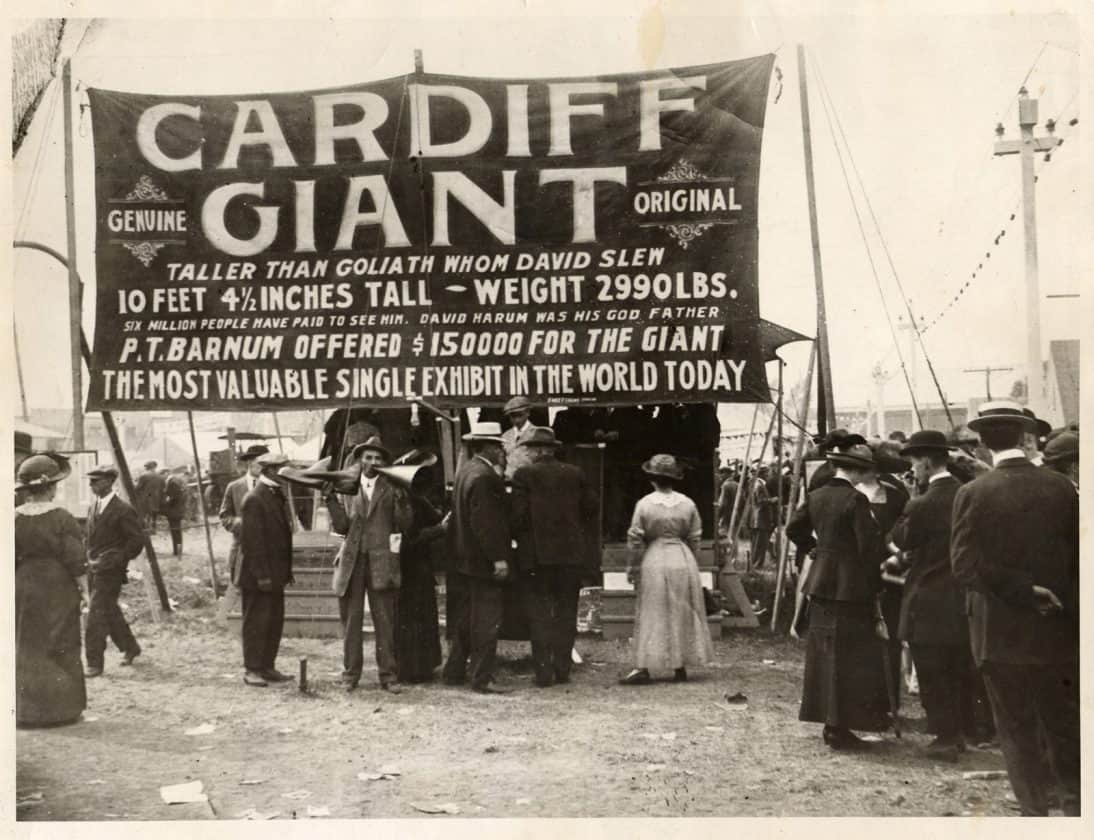
P T Barnum circus poster


He covered all bases with his posters which read : 

What is it?
               Is it a Statue? Is it a Petrification? Is it a Stupendous Fraud?
                                Is it the Remains                                   of a former Race?


Barnum’s giant drew such huge crowds, far more than had flocked to the original, that he had several more made, touring in different areas of the USA.

Then suspicions began to be aroused when a few people in Cardiff remembered George Hull and how he’d been seen in town a year before, transporting a large crate.
The men originally hired to dig the well speculated that it was a strange place to have a well and anyway, there was other access to water on the Newell farm. 


Reporters did a little digging of their own and discovered a bank transfer to Hull from Newell, shortly after the $30,000 payout.

A respected palaeontologist from Yale Univesity, Prof. Othniel Marsh, came to look at the original giant and scoffed, “It’s of very recent origin and a most decided humbug.” (fraud)

Once exposed, George Hull was even able to make capital out of that, boasting how much money he'd made from ‘fooling the world’. 


 His reason for contriving this elaborate hoax in the first place was a desire to poke fun at the fundamentalist Christian religions which believe the Bible’s claim of giants - as stated in Genesis.

He went on to try the trick again in 1877 with another buried giant, this time with a tail but was quickly exposed. 

 He died penniless and in obscurity in 1902. 


Day Fifty Two

Fascinated, enchanted bewitched and  by words…


 I grew up in England, learning to cook using scales like this.

One of the heavy iron weights was marked ‘2 lb’ but why lb?
 Fifty years later, I learned it’s from the Latin libra pondo.

My Dad also paid two pounds for a new hat; this time the sign for pound was £ but that too is really an L, stylised and also means libra pondo - or 2 pounds in weight, with a line through to indicate an abbreviation.
The lb or pound  weight was 12 ounces; the £ money was equal to a pound weight of silver. 
The abbreviations for money, thanks to the Roman occupation of Britain, which began in 55 BC,  was LSD or £.s.d = Libra, solidus, denarius.

So when Britain turned to decimal, whilst retaining the £, we lost the solidus and denarius,  a 1000 years of history and replaced them with a piddling little p.


A few years ago, I bought a multi-pack of panties but when I got them home, realised they were not my size. 
 I lived miles from the shop and only went into town once a month, so decided to sell them on an Internet site. I listed them singly and they went almost at once but one buyer complained bitterly. ‘I asked for a pair of knickers and you only sent one.’ 

Why do we say a pair of knickers or a pair of pants?  
Because way back in the 16th Century, the pants or pantaloons were two separate legs, leaving a handy, or draughty, space at the crotch, although men wore a codpiece. 
 A pant was one leg, a pair of pants both - and very few people needed only one leg.
Other than the lady who bought my knickers.


My little boy once came running in from the garden to tell me his brother had been, ‘stunged by a wops.’   

Many children say ‘wops’ for wasp, a sound change called metathesis.  We hear it in ask and asks too and occasionally in calvary and cavalry and hilariously asterix for asterisk.
 But back to the wops.  The Old English gave a choice: waesp and waeps and in Latin  it’s vespa which gave its name to those buzzing little bikes which sounded like angry waepses.

Vespa 1955


A friend in Gisborne always boasts that the gardens near her home produced the very first (and best) asparagus of the season, so she gets to eat the succulent vegetable before anyone else. 
 ‘Bought my first Sparrowgrass’, she’d say and I always assumed that was a sort of linguistic joke.  Not a bit of it.

Again with a 1,000 year history in Britain, its name in Latin being asparagus, though over generations this was often shortened to sparagus.   It underwent more changes, as wors so often do,  until in Shakespeare’s day it was sperach or sperage.


Then along came Nicholas Culpeper the herbalist who knew its true Latin name  and included it in his comprehensive herbal of 1653.
 

 As Culpeper was widely known and his herbal an invaluable household resource (as it still is today) the word came back in its original form.

By Samuel Pepys time, it was being called ‘Sparrowgrass’. He writes in his diary for 20 April 1667:
“So home, and having brought home with me from Fenchurch Street a hundred of sparrowgrass,  cost 18d. We had them and a little bit of salmon, which my wife had a mind to, cost 3s.”

 ‘Speak of the devil’ we say when someone we were discussing walks in.
Its full version, ’Speak of the Devil and he will appear’  goes back to the times when it was genuinely  believed that speaking names conjured up spirits. 


Hence we get euphemisms such as Old Nick and ‘What the Dickens!’
The Dickens, which in Yorkshire at least was shortened to Dick was a common name for Satan.

If came home filthy, Mum would say, ‘Just look at the state of you, you’re as black as Dick’s hat band’. 
It’s strange to think, in these prosaic times that people believed the Devil would actually pop up if they said his name but superstition ruled lives and seeing a black cat was enough to spoil your whole day.


  Politicians are often surrounded by sycophants or ‘yes men’ - people who agree with everything the boss says.  
The Greek word sÅ«kophantÄ“s is from sÅ«kon phainein, meaning 'to show a fig'.  
This is a very ancient superstition, widely used around the world,  to ward off the evil eye. 
showing a fig
In many places,  now seen as a vulgar insult.   

Sycophants, the embodiment of the protective symbol, perhaps fear what would happen if they dare to disagree with a politician.


 I am indebted to the meticulous research by Michael Quinion on his excellent webpage:      http://www.worldwidewords.org


Day Fifty One

Collapse of stout party... total silliness


When I was 60 I decided to throw a small party but Napoleon wasn’t available.
The first thing was to decide what food to serve.  George, the guy who lives on the 32nd floor offered to make BBQ  beef but I told him the steaks were too high.
I always like to seafood,  I remembered seeing an advert for extremely cheap fish but there had to be a catch. 

Everyone’s  favourite soup was one made from root vegetables, they agreed my 24 carrot soup was real gold.

My best friend Tony requested jelly with cream and custard.  I gave in because I didn’t want to trifle with his affections.  


 Someone else wanted cheese and crackers, a great idea, I love fireworks.

A lot of my friends offered to bring edible contributions. 

Ruth said she’d bring Devils on Horseback but I didn’t think the apartment was big enough for 24 ponies.

Jenny, who’s vegetarian suggested crudités but I wanted to keep the party clean. For the same reason I rejected the Bakewell tarts.


Mary whined about the Sauvignon Blanc,  Bill requested a mixed fruit drink but I knew he was an ex-boxer and could get a bit punch-drunk.
 Joe said the beer was too small but I didn’t plan to serve  coffee as I wished to stay grounded.

There were many reminders that I was getting older.  Maria brought a beautiful cake, shaped like a  clock. Eating that was time consuming. 


Eloise gave me an egg timer but when I tried it out, it lasted only a minute. Obviously it was filled with quicksand.
My colleague from work is a musician, always an upbeat lady, she asked me not to serve fish; she doesn’t like the scales.  She brought a gift of herbs with the note ‘Thyme is money.’

Ajit brought Vindaloo but I knew he was only trying to curry favour. It was a chilli day and he advised me to wear warm clothes. That was silly, I don’t own cold clothes.

My brother likes to remind me of my age so he gave me a calendar - its days are numbered and my dopey cousin Tarren, stumbled in looking vague and said, ‘I got past and future covered but I forgot the present.’

My casting director mate arrived with a plate of plum rolls. He’s doing well making gritty movies about sand. Even his little son is playing miner roles.

 He once got himself into a pickle, walking up and down advertising preserved vegetables.  His next job was sweeter, he got into a jam.

To preserve that job he had to eat so much of the product that his teeth started to rot. He didn’t mind, he told me he’d been to his dentist so many times he knew the drill.   


It looked as if we’d have a full house except for my friend Angela Marlin. I said I’d tell her all about it next time dropped her a line.

The only fly in the ointment was Mosquito, Peter’s dog who had an accident on the hall carpet, a real party pooper.

Despite all that, the party went with a swing - it had to be returned to Ralph’s garden.


 Stay alert! The world needs lerts.

Day Fifty

The Mothers of Invention


Wherever you are in the world, you own, are probably using, or can see something invented by a woman.
  
Women have been inventing since time began but so often were not allowed (sometimes by law) to claim or patent their ideas and machines. 

In order to get something useful onto the market, they had to ask aman to register it.  Black women inventors had to resort to asking white men to help.
Ellen Eglin

Ellen Eglin (b.1849) invented the mangle or clothes wringer. 
At that time, laundry was washed by hand in a tub of hot, soapy water, scrubbed on a washboard and then wrung out. Then repeat to rinse.   Even large, linen bed sheets, curtains and huge, banquet  table cloths were processed this way.

Ellen knew if white women were aware a black woman had invented such a device they wouldn’t buy it and hard-working laundry maids across the USA would be deprived of something she knew would make their lives easier.  So with a remarkable spirit of altruism, she decided to sell, for a mere $18, “to a white man interested in the idea.”
The mangle went on to be a world-wide best seller, revolutionising not only laundry but much more.
Nurse Caroline Halstead

William Halstead is named as the inventor of rubber gloves but it was his wife, Caroline (1861-1922) a nurse who, having developed dermatitis at work, suggested he develop this idea. 
They worked.  Caroline used them in the operating theatre ever after, often to the scorn of surgeons who did not even wash their hands between patients.


Josephine Cochrane, (1839 –1913) the daughter of an engineer,  invented a commercial dishwasher after the hostess at a party complained her crockery had become chipped. 


As we switch from plastic bags (forget all those disposable gloves in landfill) to paper, we have Margaret Knight,  (1838-1914) to thank for the flat-bottomed paper bags which, with any luck, won’t deposit your leaking milk bottle and eggs on the pavement as you walk home. She also invented the machine which constructed them; the sash window and numerous other devices, including an Internal Combustion engine.
 She is not even mentioned on the Wikipedia page which covers that, only men are listed but here’s the proof.
Knight's Combustion engine


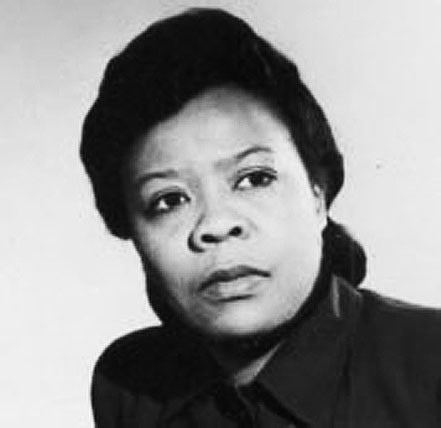
Ever wondered why we say ‘there’s a bug in the system’ when  computers go wrong?  That’s thanks to  Grace Hopper, a brilliant mathematician.  She devised a ‘compiler’, the first software,  which gave computers instructions.

 She once found  a moth in the Harvard Mk 1, seen above, hence the word debug.
Her inventive ideas were not popular with male computer programmers, then using only hardware. Grace suggested ‘software’ was the answer to their many problems
Grace and the unhappy men from Harvard
 Undeterred, Grace worked on her innovations, offering the mathematical solutions to a few leading computer programmers.  She was soon inundated with requests.  Thus inventing both Open Source and the first effective ‘software’, later named COBOL.

People who love tropical fish have Jeanne Villepreux-Power (1794 - 1871) to thank for the aquarium. 
A marine biologist, wanting to study the Nautilus, she was convinced, against popular opinion that it made its own shell. She proved this.

The Landlord's Game, invented to teach the (sometimes evil) ways of Capitalism was the brain-child of Elizabeth Magie (1866 –1948) a game designer who  patented the idea in 1904.
It was not only a teaching device but a popular party game and at one of Magie’s dinner parties, Charles Darrow and his wife so enjoyed it, he asked for the rules.  He then went on to change it slightly and “invent” Monoply.
Myra Juliet Farrell

Australian Myra Farrell  1878 –1957) at just 10 years old, had the idea of the self-locking safety pin. She  patented many inventions: a folding pram hood, a method for automatically picking fruit, a baby sling and a press stud which doesn’t need stitching.

Also in the realm of baby care: Susan Olivia Poole 1889–1975, of Ojibway/Chippeway heritage observed how mothers would tie babies securely into a ‘papoose’ and hang this from flexible branches so the bouncing motion soothed the child.  Thus was born The Jolly Jumper, used and enjoyed by millions of babies around the world, mine included.


The wonderfully named Eldorado Jones, 1860–1932 invented a muffler to deaden the noise of aeroplanes.  People living near Heathrow  and Gatwick should probably alert the airlines about this 1931 invention.

Nicknamed, ‘The Iron Woman’ who mainly employed female worker over the age of 40 in her factory,  she also gave the world a lightweight electric iron, a travel-sized ironing board and an anti-damp salt shaker (whatever happened to that brilliant idea?)


Patrician Bath, pioneering Opthalmologist
Opthalmologist, Patricia Bath 1942 – 2019) developed and pioneered laser surgery for cataract removal, including improvements to the laser probe which delivered it.

How many military and police lives have been saved by the bullet resistant, stab-proof vests and combat helmets?

That’s thanks to Stephanie Kwolek (1923 –2014) and her invention - Kevlar.

Chemist, Stephanie Kwolek
Kevlar is heat resistant and many times stronger than steel.  
In an interview, Kwolek, stated:
Once senior DuPont managers were informed of the discovery, they assigned a group to work on it.”        The group did not include its inventor.

 DuPont and not Ms Kwolek profited from her invention, although they gave her a medal.
Kevlar  is used in a myriad ways including:  combat gear, parachute lines, fire fighters’ boots, cut-resistant gloves and armored cars, bomb-proofing, hurricane rooms and bridges as well as in many sports applications.


Women inventors also gave us:  fire escapes (Anna Connelly); life rafts (Maria Beasley); Solar Heating (Maria Telkes and Eleanor Raymond); the refrigerator (Florence Parpart).
Florence Parpart proudly shows her fridge 

 Alice Parker invented central heating) and  Ada Lovelace, daughter of the dissolute poet Lord Byron, came up with the algorithms which allowed computers to change the world.

 Maria van Britten Brown made a safer world when she invented Closed-circuit  TV as a result of the slow-response of police to call outs in her area.
Maria Brown inventor CCTV

.
Women have been pioneers and inventive in every single walk of life and I could fill a book with their amazing discoveries (and many authors have).


Just one question. 


We have coffee filters (Melitta Benz) fridges, irons, ironing boards, dishwashers to make domestic life easier but why hasn’t someone invented a kitchen-sized,  reasonably priced automatic multiple potato peeler?  
Day Forty Nine

Wake me early Mother, for I'm to be Queen of the May...


In the third week of May, Whetley Lane Infant’s School in Bradford, prepare for May Day.

Like all the girls in our class, I longed to be May Queen but who would choose a dumpy 6 year old with short, dark hair over the willowy girls with blonde hair almost as long as Rapunzel’s?  
But I was chosen to be an Attendant and was overjoyed.
I'd been a bridesmaid to my Auntie, so already had a dress

Naturally, all the girls were excited about May Day: dressing up, parading down the road in our finery,  dancing round the Maypole all appealed to us.

By coincidence, these were all the things the boys hated.

Our teacher tried to make the traditional dances sound macho, explaining it took stamina to dance ‘Knives and Forks’, ‘Fourpence Ha’penny Farthing’, ‘Strip the Willow’ and the wonderfully disgusting  ‘Dick’s Maggot’.

Colin the rebel said.  ‘ I’ll do yon Dick’s Maggot one but I'm not dancin’ owt else, it’s fer lasses.’ 
This encouraged rebellion by the other boys.

Our teacher was wise; she didn’t argue.  The next thing we knew, the Headmistress was standing before us, looking at the dissidents over her spectacles.
 ‘I understand some of you don’t want to  practice the May Day dances.’

‘Aye, it’s soft.’ said Colin, bravely as we all quaked; none of us would dare to cheek a teacher, let alone the Headmistress.

Mrs Twizleton was unmoved.  ‘These dances are part of our heritage and men as well as girls have danced them for hundreds of years. Ask your fathers. I taught them all and they danced.’
Deprived of this usual Court of Appeal, the boys gave in.

Maytime was when Nature came into her own after a long, hard winter and thanks to caring teachers, city children learned about woodland flowers and trees, things they never saw in their day-to-day lives.
Miss Sym brought large bunches of bluebells and daffodils to school for our Nature Table and they filled the room with their fragrance.

 She explained that like all things in nature, they were gifts from God.

Maureen put up her hand, ‘Please Miss, did God bring 'em  to your house, like Santa brings toys at Christmas?’

‘Don’t be daft,’ Colin was scathing. 

 ‘No, not quite,’ Miss Sym ignored the critic, ‘I picked them in Bingley Woods.’
‘Did God say you could?’ asked Stephen.
Our teacher looked disconcerted, ‘Well, not quite Stephen but….’

Bluebells in Bingley Woods 

‘So you pinched 'em Miss?’ He looked scandalised, ‘me Mam says you musn’t take stuff wots not yourn.’
’And she’s quite right, we must never take things which don’t belong to us, that’s stealing  but God made these flowers for us all to enjoy, so we are allowed to pick them.’

‘That can’t be reight,’ Colin always had a comment, ‘I picked some tulips from West Park for me Mam’s birthday, ‘an Parky came and told me Dad and I got strapped fer it.’

The week before the May procession, we made tissue and crepe paper flowers to decorate our bikes, trikes, prams or scooters.
‘Can I ‘ave black tissue paper fer my scooter?’ asked Jim but was disappointed.  ‘Grey then, or brown’ll do.’ 

Inevitably, Colin’s hand went up ‘Please Miss, I don’t ‘ave a bike an me brother‘d nivver gi’ me a lend of his.’
 ‘Don’t worry about that,’  Miss Sym, always kindly, reassured him, ‘I’ll arrange something.’
So Colin, whistling happily, set about making  ‘sissy’crepe flowers.


For the next couple of days we wound blue, green and yellow crepe paper around the frames of trikes and scooters and glued paper flowers and streamers to the handles and wheels of prams until they were almost completely hidden under a paper garden.

Colin had the loan of a splendid bike and took great pains to decorate it in red, white and blue, showing great artistic and patriotic  flair.

On May Day, we turned out in our best, so excited we could hardly contain ourselves and many trip to the lavvy were necessary.

Children without shoes had been given plimsolls from Lost Property and the poorest, often dressed in ragged clothing, inadequate for the weather and several sizes too big, were given white, Crusader-style  tabards tied with a bright ribbon.


The May Queen,  holding a bouquet of real, rather than paper flowers, led the procession from our classroom to the main road, her crown of honeysuckle and lilac scenting the air.  We Attendants held up her blue velvet train and looked proud.

 Behind the royal party came the rest of the school,  pushing their bikes, trikes, prams, scooters or carrying hoops festooned with paper flowers and singing lustily.

Every Mum and Grandma and even some Grand-dads came out to watch and there were calls of: ‘Eee, don’t they look grand?’
And
 ‘You’re reight little Bobby Dazzlers.’

Several of the older ladies who had done exactly the same walk in their youth,  wiped tears from their eyes.
Our  procession then made its way back to school and many of the spectators followed to watch the Maypole dancing.
Even Dick’s Maggot went well.

Colin’s father, standing at the back in his old army greatcoat, applauded enthusiastically when his son danced Dick's Maggot and Colin’s expression, formerly acute embarrassment, changed to pride.


  The Aztecs were spiritual people and among their pantheon of deities was the goddess Mayahuel who gave birth to 400 rabbits which she fe...