Day Fifty Nine

I can only give you a very small taste of each place but a Google search of any key word will tell you all you need to know.
Christchurch City with the Southern Alps in the background

Here we are in the beautiful city of Christchurch, spread out along the Canterbury Plain with the Cashmere Hills rising beyond.
 The Avon River flows through the Botanical Gardens and visitors can enjoy trips 
  by punt to the heart of the city


Christchurch has seen more than its fair share of tragedy.

Christchrch Cathedral before the quake
On Saturday 4th Sept 2010, an earthquake measuring 7.1 struck the area, causing widespread damage but with no loss of life.  

Six month later Ruamoko, god of volcanoes and earthquakes, kicked off again, this time closer to the city’s centre.
...and after
This was the strongest earthquake ever recorded in an urban area and it killed 185 people from more than 20 countries. 
Aftershocks continued and although many fled from the city, most decided to stay on and defiantly rebuild.

Within weeks a vibrant container city was open for business with banks, shops, restaurants, cafés and clubs, all housed in repurposed containers.

Although I am not, in general a city person, this place just hummed with life and  cheeky enthusiasm.
Everyone seemed upbeat and optimistic, cocking a snook at the destructive gods.


Church authorities commissioned Sigeru Ban to design and build The Cardboard Cathedral, to replace the historic stone building, adjudged beyond repair (at least for many years)
The Cardboard Cathedral

Then on 13th February, 2017  two bush fires began in the Port Hills.  Eleven houses were destroyed and 1,000+ residents evacuated but no lives were lost.
Al Noor Mosque

Sadly, two years later, an insane and armed  Australian nationalist killed fifty one people, including little children, injuring many more in a hate attack on two Islamic centres whilst people were at prayer.

Prime Minister Jacinda Ardern said it was the darkest day in New Zealand history but it led to something quite remarkable.

Thousands of non-Muslims, even gang members,  volunteered to form human chains around every mosque so worshippers could pray in safety.

Literally millions of people came out onto the streets to lay huge banks of flowers at every mosque and Islamic centre in the country. 


Muslim families, often subject to racism, were inundated with letters and gifts of sorrow and apology.
No one could believe such a horrific thing should happen in this peaaceful country.
A little later, every shop, factory, school, college, office, marae, café, church, bank and home in New Zealand, stopped for a commemorative and deeply sad silence.

 Support for the bereaved and injured poured in, as did the money: $31 million in just a few days. New Zealanders working and grieving together posted notices across the cities and on social media:
Kia Kaha = be strong
Visit Christchurch today and the flame of renewal is still bright. A lesson to the world - if you can rise above so many appalling setbacks, you can rise above anything.
Akaroa Harbour

 Take a run out to Akaroa, named Port Louis-Philippe by the 63 French settlers who arrived in 1840, believing they owned the land there,  and you’ll find yourself in a small French town.  It has a beautifully continental atmosphere whilst still being very Kiwi.  
Akaroa has such charm that many people wish to retired here.  Despite having only 630 residents, the influx of tourists makes it a very bustling settlement with all the usual gift, food and souvenier shops as well as French restaurants and cafes.  


Like everywhere in New Zealand the scenery is amazing.


Akaroa Harbour

Kaikōura is over 180  km north from Christchurch but still also subject to shakiness.
A beach at Kaikoura
On 14 November 2016 a quake of 7.8 left 2 dead and caused a tsunami. A thousand tourists and locals were stranded when the shaking disrupted transport services.   Not a bad place to be stranded really.

Kaikoura is famous for its dolphin and whale watching tours, held on strictly ecological lines so that no sea creature is disturbed.


Up the coast 200 km  and you’re in arts-orientated Nelson (Whakatū) which  hosts multiple festivals including those for jazz, blues and chamber music as well as the famous Wearable Art Festival. 
Wearable art

Enjoying a temperate climate with long hours of sunshine, it’s the ideal venue for all outdoor sports and leisure activities.  

Nelson has retained many historic old buildings but the rot set in during 2012 when an international chain built an hotel reminiscent of dismal Soviet Bloc apartment buildings.
Thin end of the unlovely wedge?


Off now to the sheltered harbour of Picton to take ferry across the Cook Strait.
Hope you're a good sailor, I once crossed in an Force 10 gale - very invigorating.

Before we do, let’s stroll around this attractive seaside town with its many cafés, galleries and restaurants.
 The Foreshore gives a calming view of the sea whilst keeping the vibrancy of friends meeting, interesting discussions and upbeat music.  

A water taxi will take you to the Kaipupu Point Nature Reserve where total peace and quiet (there is no vehicular access) allow you to enjoy bird song.


 Grab your ferry tickets, it’s nearly time to head for the terminal and the 3 ½ hour journey across Cook Strait.   

Listed in the world’s guidebooks as one of the most beautiful journeys you’ll ever take.


You may see five species of dolphin:  Common, Bottlenose, Dusky and extremely rare Hctor dolphin as well as  the Orca.  Birdlife included Australasian gannets, shearwaters, shags and even blue penguins. 

If you’re lucky you may spot a majestic Royal Albatross heading down the coast to the Taiaroa Head  sanctuary, 29km from Dunedin.


Before we leave the South Island, a word about boulders.


The Moeraki Boulders.

Maori have several  legends about these concretions: they are the kumara seeds which the gods brought to Aotearoa; or eel baskets and calabashes from the wrecked canoe, Arai-te-uru, the waka (canoe) which brought the ancestors of the Ngai Tahu people to Aotearoa
Moeraki Boulders


They have hard shells but the stone inside is crumbly.  A bit like Maltesers.

At Matakaea some 19 kilometres away, are the Katiki Boulders which contain the bones of Mosasaurs and Plesiosaurs. 


I can just imagine them emerging from this giant egg which then calcified.


Day Fifty Eight


For the next few days, we’re going to be touring Aotearoa-New Zealand, Land of the Long White Cloud - said to be the name given by the Maori explorers who saw the clouds resting above the country and knew they’d found a new home.

Maori waka
Let’s start at the southernmost tip of this very beautiful country at a place with many names:  Te Punga o te Waka, (The anchor stone of the canoe); Te Punga o Te Waka a Maui (The anchor stone of Maui’s canoe); Rakiura (Glowing Skies) or in English, Stewart Island, named after William W. Stewart, first officer of the Pegasus which, in 1809, sailed into the harbour port which now bears its name.


It is hilly (Mt. Anglem rises 3,220 feet) and well forested;  a safe haven for many flightless birds, including the penguin, for the island has few introduced predators.
Oban is the home for most of the 400+ inhabitants, connected to the mainland by a ferry which takes people to Bluff.  

Tourism and fishing are the islands main economies and I can personally vouch for the fact that it produces the best scallops in the world.

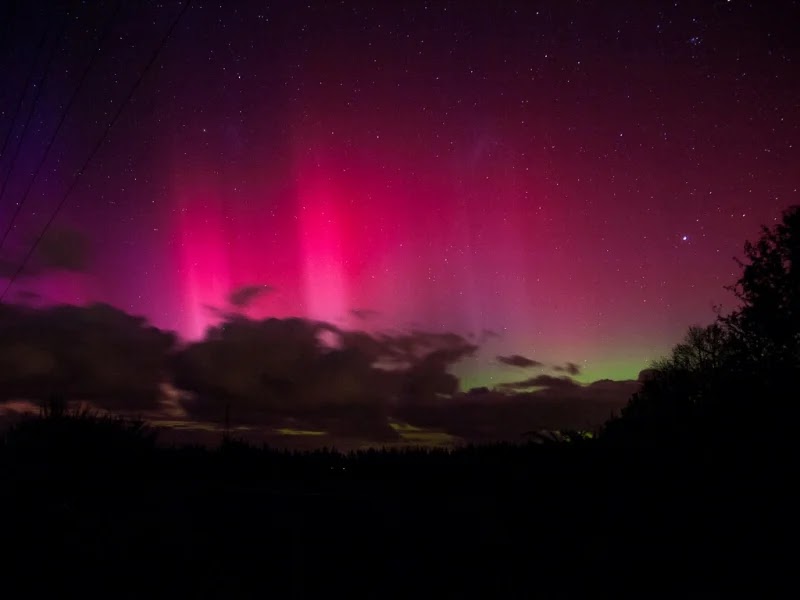
Te Punga o Te Waka a Maui, comes from the legend of Maui the demi-god who stood in his canoe (the South Island) and pulled up an enormous fish (the North Island) anchored firmly by the trusty triangular island which often sees the Aurora Australis, Southern Lights Rakiura, glowing skies.


Aurora Australis

One night, a strange thing happened to me. 
I was deeply asleep (in Auckland, 1, 264 km north of Rakiura) and woken by I-know-not-what, impelled to stand on my bed to look out of a tiny window high up in the wall.  
Something I’d never done, not even to clean it!

The sky was glowing a dull red and dancing across the horizon.
I woke my sons and pulling coats over our nightclothes we drove quickly to a nearby hill with a view over the city. 
There we watched a spectacular sight as the sky leaped and darted. 
The Aurora is rarely seen as far north as Auckland and it seemed this was the first showing in 40 years.  Whatever it was that woke me, I'm deeply grateful.


Landing in Bluff, famous for its Oyster Festival (and much more) it’s 30 km drive to Invercargill (or Waihopai in Maori) the country’s most southerly city. 


Come here to see the  architecture, enjoy the laid-back, low-stress atmosphere and the magnificent Queens Park.
Eighty hectares of beautifully kept lawns and flower beds, playgrounds and wildlife habitats.


Queens Park

 And if you have a passion for classic vehicles, this is the place to be.

Have you seen the movie, The World’s Fastest Indian with Anthony Hopkins as the enterprising and indomitable Burt Munro?  (Invercargill resident) 
Then you’ll know this New Zealander set a land speed record in 1967 on his Indian Scout Motorbike.


Burt's Bike

Burt Munro
He also inspired a love of vintage vehicles which can now be seen in the museum at New Zealand’s “Classic Motoring Capital”

A little further up the coast (208 km) is Dunedin (the Gaelic form of Edinburg) home of Otago University, the Botanical gardens and a coastline which hides in its bosom, many little inlets and bay communities.

Dunedin Railway Station


Many thousands of Scots came here during the 1800’s, hoping to make their fortunes as they landed at Port Chalmers.

 I came to the city in 1973 and found it a lovely place to live and work.  
I missed the Gold  Rush of 1861 but wasn’t too bothered about getting rich, unlike the thieves who broke into The Customs House at Port Chalmers on 31st May 1855. 
Port Chalmers
They stole a strongbox containing £1,400.  These not-so-quick-witted larrikins  hurled it against rocks, then tried a crowbar in attempts to open it but to no avail. The police found it dumped, intact, in the harbour.  
                                                            I love it when a plan comes together.


Queenstown
Across to the west is Queenstown, which, when I first knew it, was a charming Alpine town with a strict building code to protect its character.

It had a steady turnover of skiers, climbers and tourists who came for the spectacular scenery. 
The Remarkables living up to their name
Alas, big money soon came bullying its way in, got all the rules changed and built charmless monstrosities of hotels and casinos. 
It’s now no longer charming but a place where few but the very rich can afford to stay.  
What they couldn’t spoil is the scenic splendour of The Remarkables, which rise above the town in breath taking beauty over Lake Wakatipu.   

 Aoraki - Cloud Piercer, or Mt Cook

The whole of the West Coast of the South Island is extremely beautiful, with glaciers, Mt Aoraki (Mt. Cook) and delightful little townships, a world away from the avariciousness which has spoiled Queenstown

Not everyone agrees with me on this of course, some people love the modern buzz and bright lights and constantly ringing tills and gambling machines.
Lake Matheson

On the West Coast we'll also find Fox and Franz Joseph Glaciers.
Fox Glacier is easily accessed and is a major tourist attraction with over 1,000 people per day visiting. You can even be airlifted by plane to the top.


Make your way across Arthur's Pass, via the Alpine Highway, often called The Most Beautiful Road in the World.
By road or rail, you'll eventually get to Christchurch on the east coast.

Book into an hotel and we'll start our journey up country from there, tomorrow.


Tranz-Alpine Train 

Day Fifty Seven

Today I'm going to share some favourite poems with you.


Bed in Summer
Robert Louis Stevenson

It echoes every child's dislike of having to go to bed while the sun is still high in the sky and there's so much more playing to do - but for that Tyrant Time.

In winter I get up at night 
And dress by yellow candle-light. 
In summer, quite the other way, 
I have to go to bed by day. 

I have to go to bed and see 
The birds still hopping on the tree, 
Or hear the grown-up people's feet 
Still going past me in the street. 

And does it not seem hard to you, 
When all the sky is clear and blue, 
And I should like so much to play, 
To have to go to bed by day?
                             
                                                                  *******

Dorothy Parker had an unhappy childhood and despite her success as a writer, was no luckier as an adult.  She married 4 times, twice to the same man.  After her death, her ashes lay unclaimed for over 17 years.  Poor, unhappy woman - but a truly brilliant writer.
Dorothy Parker

Love Song
Dorothy Parker

My own dear love, he is strong and bold
      And he cares not what comes after.
His words ring sweet as a chime of gold,
      And his eyes are lit with laughter.
He is jubilant as a flag unfurled—
      Oh, a girl, she’d not forget him.
My own dear love, he is all my world,—
      And I wish I’d never met him.

My love, he’s mad, and my love, he’s fleet,
      And a wild young wood-thing bore him!
The ways are fair to his roaming feet,
      And the skies are sunlit for him.
As sharply sweet to my heart he seems
      As the fragrance of acacia.
My own dear love, he is all my dreams,—
      And I wish he were in Asia.

My love runs by like a day in June,
      And he makes no friends of sorrows.
He’ll tread his galloping rigadoon
      In the pathway of the morrows.
He’ll live his days where the sunbeams start,
      Nor could storm or wind uproot him.
My own dear love, he is all my heart,—
      And I wish somebody’d shoot him.
                                                         *********

Henry Reed (22 February 1914 – 8 December 1986) was a British poet, translator, radio dramatist, and journalist.


Lessons of the War: I: Naming of Parts
By Henry Reed


Today we have Naming of Parts.
Yesterday, we had Daily Cleaning.
And tomorrow morning, we shall have What To Do After Firing.
But to-day, today we have Naming of Parts.

Japonica glistens like coral in all of the neighbouring gardens,
And today we have naming of parts.
This is the lower sling swivel.
And this iIs the upper sling swivel, whose use you will see,
When you are given your slings.
And this is the piling swivel, which in your case you have not got.

 The branches hold in the gardens their silent, eloquent gestures,
Which in our case we have not got.
This is the safety-catch, which is always released
With an easy flick of the thumb.
And please do not let me see anyone using his finger.
You can do it quite easy if you have any strength in your thumb.

The blossoms are fragile and motionless, never letting anyone see
Any of them using their finger.
And this you can see is the bolt.
The purpose of this is to open the breech, as you see.
 We can slide it rapidly backwards and forwards: we call this
Easing the spring.

And rapidly backwards and forwards the early bees are assaulting and fumbling the flowers:
They call it easing the Spring.
They call it easing the Spring: it is perfectly easy
If you have any strength in your thumb: like the bolt,
And the breech, and the cocking-piece, and the point of balance,
Which in our case we have not got; and the almond-blossom
Silent in all of the gardens and the bees going backwards and forwards,
For today we have naming of parts.


Walter James Redfern Taylor was an Australian born poet and writer who left his home for England when he was just 18. He wrote the following poem in 1916.

Romance
W.J. Turner

When I was but thirteen or so,
I went into a golden land,
Chimborazo, Cotopaxi,
took me by the hand.

My father died, my brother too,
they passed like fleeting dreams,
I stood where Popocatapetl
Mt Chimborazo

in the sunlight gleams.

I dimly heard the master’s voice
and boys far-off at play,
Chimborazo, Cocopaxi
had stolen me away.

I walked in a great golden dream
to and fro from school –
shining Popocatapetl
the dusty streets did rule. 

I walked home with a gold dark boy
and never a word I’d say
Chimborazo, Cotopaxi
had taken my speech away:

I gazed entranced upon his face
fairer than any flower –
O shining Popocatepetl
it was thy magic hour:
The houses, people, traffic seemed
thin, fading dreams by day,
Chimborazo, Cotopaxi.
They had stolen my soul away.
                                                                     ********** 

 And this is one of many nonsense poems I wrote for my grandson. 

 The Bombardon 

We once had a truly amazing bombardon
All padded with vervet which came from Des Moines
It could be quite dangerous, (but we kept the guard on)
The rampikes and pronks were all weighted with foins

 The edges were colloped with many edmenage 
The doors, when they opened, revealed a bezoar
Klipspringers abounded and quite an advantage
Were fifty five cats, a zedonk and a boar.

 The things I liked best were perdicular boskets 
Which hung from the corners, all covered with flumes
They sparkled with silver, as did the pearl oskets,
Except when the mithridate gave off its fumes.
  
When father developed a bad diaeresis
He raged in delirium, ‘Sell the darned thing!’
My heart, callithumpian, heard this sad thesis
I even considered a note to the King.

 The sad day arrived, the bombardon was taken 
A gold ninnyhammer fell, clunk, to the floor
And now in the night when I often awaken
I mourne my bombardon, I'll not see it more. 


  The Aztecs were spiritual people and among their pantheon of deities was the goddess Mayahuel who gave birth to 400 rabbits which she fe...