Day Twenty

If all the world were paper

The Covid Crisis has brought out the worst in some people with  shoppers fighting, actually hand to hand fighting, over toilet rolls.
As far as I know, no one has descended to fisticuffs for fish, or offered violence to get the last pack of spinach or fluffy slippers.

Tissue is always the issue.

When I was a child in Bradford, the lavatory was outside and while Mum allowed us to use the po in the bedroom for early morning wee-wees, anything else meant a cold, often dark and rainy trip down the yard.

There I’d sit, dangling my little legs and screwing up pieces of newspaper to make them soft.
Typically, you had to screw and smooth a square of Telegraph & Argus six times before it achieved the requisite gentleness.

Newspaper was infinitely better than the Bronco tissue we were forced to use at school.
This shiny, rough paper, named after an untamed horse (!) was strangely non-absorbent and had the order NOW WASH YOUR HANDS! Printed on every sheet. 

It was totally unfit for purpose and its advertising slogan, ‘Bronco for the bigger wipe’ only compounded the consumers dislike of it.  


Image courtesy of the Science Museum, London.

In ancient times, depending on where you lived and when, a visit to the loo meant taking leaves, grasses, clay, moss or wood shavings (how on earth did they keep them together?) 
Other wipers included corn and maize cobs,  fruit skins, seashells, stones (ouch)  and for the wealthy English, lace, wool, cloth and, much later,  paper from books and music scores. 
I cringe to think this is why Shakespeare’s plays  were lost.

The Romans used a sponge often soaked in vinegar (or if you were  wealthy, rosewater), attached to a stick.
When I first learned about this, I wondered if this implement,  offered to Jesus on the cross was not in fact to assuage his thirst but as a kind of bizarre insult, the fore-runner of the Abu Ghraib scandal.

In many countries, even today, the left hand is used, which is why some cultures will eat only with the right.  NOW WASH YOUR HANDS!

The first people to use paper were the Chinese, the earliest known toilet paper or 衛生紙 was recorded in AD 589. 
Yan Zhitui (I promise I’m not making that name up) wrote that he dare not use any paper for wiping which contained classical Confucian texts.

During the 14th century, Emperor Hongwu’s family used 720,000 sheets (2ft x 3ft) per year of a special soft and perfumed  paper fabric in their luxurious loo.

Here he is on the throne.


It wasn’t until the 1850’s that that a  New York entrepreneur,  Joseph Gayetty produced the first commercially available sheets as, ‘The greatest necessity of the age!’  
However,  despite being softened by aloe vera, or maybe because of it, they tore into holes when used.
NOW WASH YOUR HANDS!

It would be 20 more years before toilet paper would be produced in perforated rolls and even then the quality of the paper, made from wood chips, was so poor that people often risked splinter in the bottom.  

We’ve come a long way to get to the ultra-soft stuff worth fighting for but stories have emerged recently that thanks to Covid-19,  many of us are still not on a roll but have been reduced to using cloths, newspaper and even junk mail.  Best thing for it.


Day Nineteen
Laughter is the best medicine

 A collection of bizarre and interesting things to brighten your isolation.

A friend and I have been reminiscing, by phone of course, about the old days.
‘Hey, do you remember those things we used to keep in the bathroom, I think they were called toilet rolls?’

Girlfriend: Are you coming over tonight?
Boyfriend: No,  I’m self-isolating
Girlfriend: (in cajoling voice) But Babe, my parents won’t be home
Boyfriend:  Well they should be!!


On Easter Sunday, the huge  statue of Christ the Redeemer which stands 30ft high atop Corcovado Mountain in Rio de Janeiro, Brazil,  was lit up to look like a doctor and the words "Thank you" in several different languages, as a tribute to health workers.


Girl: Dad, why did you call my brother ’Paris’?
Dad: Because your Mum and I were in Paris when he was conceived.
Girl: Oh, I see, thanks for explaining.
Dad: No problem, Corona.


'Don't forget Rapunzel was in isolation for years but still managed to meet the man of her dreams.'


Actor Leslie Phillips tell of a letter he received from a landlady after he’d written  to book a room.
‘Dear Mr Phillips, I have a very nice front and a very nice back and you can have which ever you like. The lavatory is outside but you may use the piano.’


Lego encouraged its enthusiasts to make models and upload their results to the Internet but to their consternation,  saw some of the little Lego people had acquired additions.

Typically, Lego people don’t have what a spokesman called ‘intimate parts’ which is probably why Lego people look more grumpy these days.
To prevent offence, Lego commissioned special software which could detect the naughty bits and alert HQ.

Lego is, astonishingly, also used as prosthetic legs for tortoises.


Brookesia Micra is the smallest chameleon species on earth.  Here it’s seen on a match head.


Trump, the man whose name actually means ‘fart’ (if you come from the North of England you already know this)  is an award winning actor. 
He appeared in ‘Ghosts Can’t do It.’
Neither could he apparently, the award was a Razzie (Golden Raspberry) for Worst Supporting Actor.


It’s very easy to mis-hear things:
What are your intentions?  Can also be, ‘What are urine tensions?’


The Sound of Music, one of the most loved musicals of all time, was banned in China as being ‘capitalist pornography’ - the reason?  The song, ‘The Hills are Alive’ was deemed to be about Maria’s breasts. It obviously gained something in translation.


Jing Mei decided she would like a very special wedding dress when she married fiance Jian in 2014. 
The train would be 3 miles long.
 It  weighed 120lb and took 40 bridesmaid's to hold it.
When questioned by a reported, Jian, a man who clearly started as he meant to go on said, 'It's her day, what she says, goes.' 


It was a Victorian custom and prevailed well into the 1940’s, for fathers to arrange  to have their daughters' teeth extracted prior to marriage.
The teeth were then presented to the groom as a gift.

As tooth hygiene was not particularly good in those days, many people had gum disease and extensive decay by the time they reached marriageable age.
This strange tradition was ostensibly to prevent costly dental treatment later but I’m sure the idea of kissing someone with a mouth full of decaying teeth didn’t appeal either.
I could not discover if the same fate was forced upon the groom.
 

Students at Trinity College, Cambridge were prevented, by an ancient law,  from taking their babies into college.
So the college re-defined babies as cats.

Lord Byron, outraged that Trinity would not allow him to keep a dog in his rooms, carefully perused the documentation - then bought a bear. The rules did not forbid bears. 
  

Doug and Sam, a couple of hunters,  are out in the wilderness when Sam suddenly falls to the ground.
Doug rushes to help him but can see no injuries.
In panic, he rings the emergency services, ‘Help, help, my buddy’s dead, my buddy’s dead!’
The soothing voice at the other end says, ‘First of all sir, be calm.   I need you to make sure your friend is actually dead.’
The operator holds on, hears a shot then Doug says, ‘Okay, now what?’


Day Eighteen:


Is Lockdown more bearable when the weather is warm and sunny, or like today in Waitakere, when rain is being bowled down my road in great clouds, by wild and shouting Antarctic winds? 

The 30 minute walk (if you’ve been lucky enough to take one) , the bike ride or kickabout in the street, is impossible in bad weather.

If you are confined with bored, energetic children, weather which keeps you all indoors can be even more of a challenge than usual. 

Those adults who have previously limited screen time in favour of more worthy pursuits, may now be blessing the fact that their child can get so absorbed in a screen that s/he doesn’t even recognise their own name!
 
There are many things online which can interest children of all age.

YouTube is a positive cornucopia of entertainment and learning.  

Decide what subject you want to explore: animals, plants, crafts, cooking, birds, science, planets, history, maths, music or film and search it. 
There’s something for everyone.

For children who love animals, try searching ‘David Attenborough’; ‘BBC Earth;  ‘Animal programmes’ or ‘National Geographic Kids.’ 

Be aware though,  that some videos can include  ‘nature raw in tooth and claw’  which might not be suitable for younger children.
 
My grandson likes to change the play speed to 2, which makes everything faster and funnier!

Discover Morph:  this wonderful stop-motion  animation has delighted multi-millions of children since 1977 when Peter Lord of Aardman Animations  (now famous for Wallace & Gromit) created him for the Tony Hart programme.


Morph is now a classic and still so popular that when Peter appealed for £75,000 from crowd-funding, to make 12 new episodes,  he gained and surpassed the total in just 9 days.
Here’s a 1-hour animation to introduce you:

Other subjects to explore which may keep restless children happy include: optical illusions, puzzles, riddles, rebus;  party games, guessing games, quizzes and jokes;  making, composing and playing music and instruments - even from household objects.


Screen time doesn’t have to be mindless.

If the weather in your part of the world means you or your children are finding confinement a challenge, these ideas should springboard you to an interesting day or two.      


Day Seventeen
Are we nearly there yet?

Yesterday, I used the last of the wool with which I knit hats, scarves, slippers and bags. These are donated to a local food bank or sometimes to the Hospice Shop. 
So now, with nothing to do with my hands, I feel useless and irritated with myself.

This is the first day since Lockdown began that I’ve felt totally unmotivated and dull. 
I didn’t shower and dress until after my 10 am breakfast and then, with little impetus to do much else, decided to ring a friend.

During the course of our conversation she asked, 'Do you still take those online courses?'

And there was my answer!  

A few years ago I discovered MOOC - Massive Open Online Courses. 

These are run by universities around the world who offer a whole range of subjects including health, literature, forensics, history, creative arts, law and much, much more.  Best of all, they are completely FREE.
.
The courses are 3- 6 weeks long and allow you to dip in and out whenever you have the time.  You are in total charge and no one minds if you miss a day or 4.  

In addition to information and videos provided by experts, there are comments from other learners, which gives a pleasant and often stimulating interactive discussion.

So  I’m about to sign up again, this time to Artificial Intelligence, a subject which fascinates me as I use AI at home but know little about how it works.

After that I may take The History of Fairy Tales or Forensic Facial recognition or The World of Spies - keeping your secrets safe.  

https://www.futurelearn.com/courses 

 Our physical exercise may be severely restricted but we are still able to keep our brains active.    The world is still our oyster when it comes to learning.


You can also learn a great deal from the hundreds of podcasts online. I'm currently listening to CrowdScience from the BBC.

https://www.bbc.co.uk/programmes/p04d42rc/episodes/downloads


 But the BBC also has podcasts and feeds on pretty much every subject too.
https://www.bbc.co.uk/sounds


Learning online is the one thing Covid-19 has not restricted.


Well, perhaps not the one thing…….


Day Sixteen

We are currently about halfway through Pesach or Passover, the Jewish commemoration of the escape from Egypt and slavery. 
The ancient, traditional sacrifice was a perfect lamb.

Today is Easter Sunday, which Christians celebrate as the escape from after-life condemnation and punishment.  The sacrifice in this case: The Lamb of God aka Jesus.

In neither case will the celebrations be what we are used to.

No family gathering, unless the family  were already in your bubble. 
No Easter Egg hunts by excited children and certainly no congregating in shul or church. 

Our traditions and celebrations are indications of who we are.  We delight in the shared experiences of cultural customs and we come together to share in that joy because we need them.

This year, sadly,  we’ll be denied those gatherings - but that is our sacrifice for the greater good.

April has many more day of commemoration and celebration:

 April 19th-25th is Medical Laboratory Professionals Week.

 All over the world, laboratories are humming as the professionals look for a Corona virus vaccine and trial drugs which will cure the already sick.

19th-25th  is also National Volunteers Week, this year particularly  apt as hundreds of thousands of volunteers have stepped forward to support and help during the C-19 crisis.
Bless your hearts.

April 24th-30th will be World Immunisation Week. According to their web site, the theme this year is Vaccines Work for All,  the campaign focussing on, “the people who develop, deliver and receive them are heroes by working to protect the health of everyone, everywhere.”   Amen to that.

Other dates include: St George’s Day, celebrated in the UK on 23rd, as is Shakespeare Day.

ANZAC Day 25th April.  This is one of the most important days in the New Zealand and Australian calendar - it unites people. 

 In every town, city and community across both our countries, the Dawn Service (or sometimes later) brings out proud  Kiwis and Aussies of all ages. 

Typically there’s a parade of veterans and other personnel who have served and are still serving in war zones. 
Emergency Services take part and are accompanied by Cadets, Scouts, Guides,  Brownies, Pippins and other school children.

We do it to honour the sacrifices they made and are still making,  to keep the world safe.

This year, we too will be sacrificing - and it will be hard - our right to gather and honour. This time in order to keep one another safe.

At the end of the last Seder of Passover, there’s a traditional saying: 'Next year in Jerusalem'.
It speaks of hope and confidence in the future and in this, wherever we are, we can participate.


Day Fifteen:
Thou shalt not lie - but I do

Every few days, a caring support lady rings to ask if I have developed symptoms of Covid-19.  This is a necessary precaution as I’m locked down and my family, right across the city, are similarly isolated.   No one to keep an eye on the old codger then - except my young support lady.

I am normally a truthful person and she’s doing a magnificent job so it pains me to have to lie to her.  But there’s a good reason.

I hear the echo of my mother’s voice saying, ‘There is NEVER a good reason to lie.’
This, as she glibly told numerous  ‘white lies’ whenever she deemed them necessary.

So after the normal greetings, I gird up my loins to tell white lies and
our conversation goes like this:

‘Have you been coughing?’
‘No.’ 
I’m lying.
According to Australian Ear, Nose & Throat surgeon,  Dr John Rubin, the lack of lubrication as we age, irritates the throat, causing us to cough and clear our throats more often.  I do that all the time.


‘Have you been sneezing?’
‘No.‘ 
Again the untruth.
I  sneeze  a lot.  About 5 or 6 times every morning, as did my mother when she got to her 70’s. 
It’s thought our nasal passages cannot cope with allergens as they did when we were younger and this is the body’s way of expelling them.


‘Do you have a runny nose, itchy or streaming eyes?’
‘No.’ 
 Like many people over 60,  I’ve been suffering from allergic rhinitis for over a decade.  When it first began I consulted my doctor.
 She told me little  can be done.
 Allergy specialist Stephen Foster at Kent and Medway National Health Trust would agree.  He believes  the immune system of older people can be compromised by stress and illness, leaving us less capable of dealing with allergens.

At this stage in our conversation I am inwardly squirming, hating the deception and longing to tell the truth. 

‘Do you have a temperature?’
‘No.’
Finally, this is true and makes me feel marginally better.

‘What about watery eyes?’
‘No.’
Epiphora, or watery eyes has plagued me for well over 12 years. 
For the first 30 minutes of the day, a constant stream of tears are being dabbed away.  Gradually, after 2 or 3 tissues, it slows down and I revert to being my normal,  partially sighted self.
 Rob Hogan, an optometrist at iCare Consulting says it’s caused by age-related narrowing of the tear duct.  Since ducts act as drainage, if they contract, eyes overflow.

‘Have you lost your sense of smell and taste?’
‘No.’
The correct answer to this is, ‘sometimes’. 
Quite often in the early morning, my nose runs so much  it’s impossible to smell anything.  It also runs if I drink hot tea or coffee, or eat a hot meal.  
This has an effect on my taste buds but once the meal is over,  my sense of smell is so acute, I can smell next door’s shower gel as it runs down her drain.

At this point,  I wish I could tell my nice support lady an old but cute joke but ours is a serious conversation with a serious purpose, so I refrain from sharing.

And the reason why I am lying through my teeth?

If I answered a truthful 'Yes' to her questions, her next action has to be a call for an ambulance which, equipped with nice people in white haz-mat suits, would take me away to hospital isolation and tests which I know would be negative.
 
All the symptoms from which I am suffering, pre-date Covid-19 by many years and quite frankly, I’d be wasting precious reserves and time and the energies of already exhausted health workers.  

So I lie.  In a good cause. I’m quite well, I’m just old.

And the cute joke?

‘If your nose runs and your feet smell, you’re built upside down.’


Day Fourteen:

Whoever decided upon  ‘Happy Birthday’ as the ideal length for hand  washing against possible C-19 germs, has in one dark stroke, turned it from one of the best loved refrains,  into the most hated.  


It will be forever linked with the virus and the appalling death toll as ‘Ring-a-ring of Roses’  is, correctly or not,  associated with the Black Death.

How many bereaved families are going to want to sing that at the next family birthday?

How much better it would have been to ask people to count slowly to 100.


Day Thirteen:


Day Thirteen:

I’ve been reading about Covid Conspiracy Theories (well, you have to do something during lockdown).

Some are a little bizarre, to say the least.  

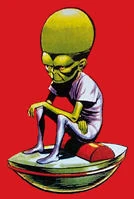
Are we really part of an experiment by aliens?

The Mekon | Villains Wiki | Fandom
Douglas Adams first made this point in H2G2, The Hitchiker's Guide to the Galaxy (1978).

Some believe we’re in the power of multi-nationals whose evil geniuses have planned to take every penny from our pockets and bank accounts. 
If so, they seem to be succeeding beyond their wildest dreams.

One report has it that we’re being ‘softened up’ by enemy powers prior to invasion.
That’s scary but rather more Star Trek than fact....a bit like Trumps' new space logo.
Trump unveils divisive logo for new Space Force military branch

Do the ‘enemy’ intend  invading every country of the world simultaneously whilst we’re still highly infectious?

The Duke of Wellington famously said, "Time spent on reconnaissance is seldom wasted," and normally one would look for a build-up of military and hardware, to indicate an  intention to invade.  

In this case, we’d need to look at a huge increase in the sale of sewing machines as civilians and support staff are pressed into service making billions of face masks for potential invaders.


In the main, cons- piracy  theorist  both expose and allay their own fears as they seek to prove themselves astute and perceptive.  
They aim their peculiar claims at any group they dislike, decry or despise. 

Well, I may as well join the barmy army.  As Corona sweeps the world,  I'll choose something I don't particularly like and blame them for the outbreak.

It's all the fault of fresh coriander leaves.

Buy Kothamalli / Coriander Leaves Powder Online New Zealand [ NZ ...


Day Twelve:


Day Twelve:

And now - the good news.

Yes, in amongst all the bad stuff, there are a few sparkles of joy and hope.
 
  • The Oxford Centre for Evidence Based Medicine (CEBM) revised their estimate of Covid-related deaths to 0.1–0.26%. 
They also say that due to an acute lack of testing equipment, it is likely many death currently attributed to C-19, in a ‘better safe than sorry’ statistic, are not related to the virus at all but from pre-existing health issues.  They state that even if the patient has tested positive, it is still not certain the virus itself was the fatal factor.


  •  Across the world, researchers have raced to find a vaccine and the University of Queensland Centre for Clinical Research,  say they have already identified two already registered mediations which have completely wiped out the virus in test situations.
  •  World-wide, people have flocked to give help and support. 
  People have given time, expertise, experience and money. Biologists, statisticians, engineers, civil servants, medics, supermarket staff, logistics managers, manufacturers and the ordinary, good-neighbour have given tirelessly.
The level of unselfishness and altruism has been unsurpassed.

There are still many, many good people out there. 

  •  Proving that necessity is still the mother and father of Invention, new ways of working, new research and new pathways for all walks of life will make it much easier to cope with future disasters, as well as normal life.  
  • Ordering goods online has increased which in itself will be more convenient for the consumer,  lead to more jobs delivering,  revive the failing postal services and lead to less travel and pollution.
 
  •  Young engineers have cobbled together cheap and  effective ventilators from all manner of equipment, including scuba gear.  These designs have been made available free to medical facilities across the globe.

  •    Sewing machine in every corner of the world have whirred night and day, turning out millions of masks for at-risk workers and others.  Most of the masks, as well as the time and materials,  have been given free.
In my own area, Haven Falls Community Trust's workers made and distributed, free of charge, 2,300 masks.


Newspapers who have known for decades that humans are more attracted to bad news than good, have nevertheless, featured a Good News Page.
This includes news of the many cities where pollution has dropped due to the stay-at-home policies  keeping vehicles off the streets and canals. 
In Venice the water is clear for the first time in decades.


  •  Pollution, which in itself leads to thousands of death each year,  has meant fewer health problems

  •  China has now lifted restrictions on movement after ten weeks. Fourteen temporary hospitals in Wuhan have been closed as people recovered and returned home.  Let’s hope this pattern can be repeated  in other countries to.

  •  Uber Eats in the USA decided to waive all delivery charges as a way of supporting local restaurants and cafés. 
 Please don’t flock to New Zealand’s UberEats as we are  on complete lockdown in order to prevent the spread of Covid-19.  The service as well as all restaurants and cafes are  closed.

  • Several celebrities, Elton John included, have given concerts and readings from their homes in place of the live entertainments their fans would normally enjoy.
Many people have compared the Covid Crisis to war-time.

 We are under seige and the enemy is at the gates but the best of humanity comes out in adversity and what is happening around the world is a wonderful defiance and determination not to be beaten.  
 

Day Eleven:


Day Eleven:

I awoke this morning to a sound I hadn’t heard for a long time: the hum of traffic on the distant motorway.  
The main road near my home is also buzzing with vehicles. 

When I say ‘buzzing’, I mean one every couple of seconds, not the nose to tail convoys usually experienced on the busy West Coast Road.

 Residents and visitors to our small road often sit at the junction, unable to get out and sighing with impatience at the constant stream of cars, trucks, buses and bikes.

The more forceful ones, usually courier drivers in their brightly coloured vans,  edge out inch by inch until an oncoming motorist gets the hint and lets them into the stream.  Otherwise they’d spend precious time-is-money, waiting for what seems like hours.  
Introducing Dedicated Services
So obviously, despite the fact we’re still at Level 4 Lockdown here, many people are on the move.   

Perhaps they’re volunteer workers, stepping in to relieve exhausted medical and support staff?    
Perhaps they’re shoppers, still feeding their addiction for yet more beans, spaghetti and cleaning fluid?

Or maybe just stir-crazy rebels, desperate for pastures new.
Who knows?

I’m still stuck here, a non-driver and dependent upon people who, at the moment, are not allowed to have any contact with me.

This includes my normal home-support workers who, in better times, would be here on Mondays and Fridays to help me buy essential food.

The agency who employs them has decided,  despite the fact I am in the 'elderly and vulnerable' category,  to withold this care, including buying vegetables and essential supplies.  
They know I cannot do this for myself.    I phoned them; they didn't seem to care.

It's fortunate then that for a number of years, I've been a member of a Maori social group and in the Maori world, elders (Kaumatua and Kuia) are regarded with respect - and their wellbeing prioritised.

So while my world,  the world of the Pakeha (non Maori) has decided I am not worth helping,  I will be supported by a Maori organisation who will bring me a box of vegetables, groceries and hygiene products (gloves, anti-bacterial wipes, toilet rolls etc).

God bless them.


  The Aztecs were spiritual people and among their pantheon of deities was the goddess Mayahuel who gave birth to 400 rabbits which she fe...